Pierre Bonnard: Previously Unseen Drawings at the Salon du Dessin
Bonnard’s Line: Drawings from the Estate of Madame Terrasse
From March 25 to 30, 2026, the gallery will take part in the Salon du Dessin at the Palais Brongniart in Paris. On this occasion, it will present, alongside works on paper by Eugène Delacroix, Edmond Cross, Camille Pissarro, Paul Jouve and others, an exceptional group of previously unseen drawings by Pierre Bonnard.
Andrée Bonnard, the painter’s sister, married the composer Claude Terrasse in 1890. The family life of the Terrasse household, with their five children—Jean-Claude, Charles, Robert, Renée and Eugénie (Vivette)—became a major source of inspiration for Bonnard.
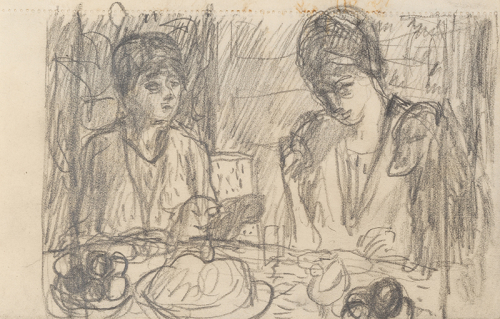
At Le Clos (Grand-Lemps), the Bonnard family property in Isère, the artist shared an intimate domestic life that he captured with pleasure through photography, drawing and painting. The family gathers in the garden on a sunny afternoon; the children play in the basin, Charles and Jean study their lessons, and Andrée feeds Charles and Vivette at the kitchen table.
Having no children with his wife Marthe, Bonnard became a sensitive and fascinated witness to these years, watching his nieces and nephews grow up. He illustrated the musical scores of his brother-in-law Claude, and the Terrasse family remained unwaveringly devoted to his work.
Charles later became an art historian and Chief Curator of the Château de Fontainebleau, publishing on his uncle and other painters of his time. His son Antoine, in turn, became one of the foremost specialists of Pierre Bonnard. Throughout his life, with the help of his brother Michel, he worked tirelessly to promote his great-uncle’s work, both in France and internationally.
A well-known legal dispute concerning the artist’s estate later brought the Terrasse family into the public eye. In December 2013, a major auction dispersed the Antoine Terrasse collection following his death.
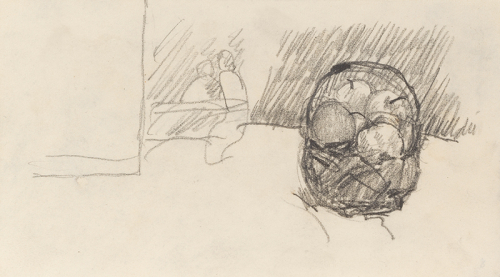
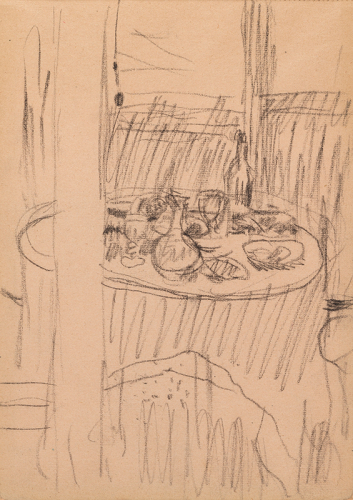
The drawings presented here belonged to Françoise Terrasse, the more discreet sister of the twins Antoine and Michel Terrasse. Taken from several of the artist’s sketchbooks, they often depict the Grand-Lemps property or a stay in Arcachon, where Bonnard observed nature with great sensitivity.
Sometimes annotated on the reverse in Antoine Terrasse’s hand—who found in them a valuable source of insight into the genesis of the paintings—each drawing offers a moving testimony to the development of the artist’s work.
From the simplest sketch of a tree or landscape, suggesting movement through sinuous and dynamic lines, to more structured sheets already organising pictorial space through hatching, each fragment allows us to perceive Bonnard’s line—before it is ultimately overtaken by colour.